
Shocking music
Music that has altered my sense of what is music - what about you?

In 1980, art critic Robert Hughes wrote and narrated a BBC series titled “Shock of the New.” This pictorial history of 20th Century Art book was also released as a book, “Shock of the New: Art and the Century of Change.” I don’t know the book or series, but I found the title provocative. It seemed worth pondering.
“Shock” of course alludes to the strong reactions elicited by novel or groundbreaking works. Hughes was interested in the visual arts, while I’m focused on music. It may be self-evident to you or me that the premiere of many sonic works felt shocking at the time. A single work could elicit surprise or amazement in some but distress and discomfort if not anger in others. New 20th Century work indeed felt shocking.
Here are a few 20th Century musical premieres that were received with shock:
- Igor Stravinsky’s music for ballet, “Le Sacre du Printemps” (1913)
Performed here with the Joffrey Ballet’s 1987 re-creation of Vaslav Nijinsky’s original choreography
- John Cage’s “4:33” for piano [in which the only sounds are those in the room] (1952)
- Ornette Coleman’s first appearances at the New York club The Five Spot (1959)
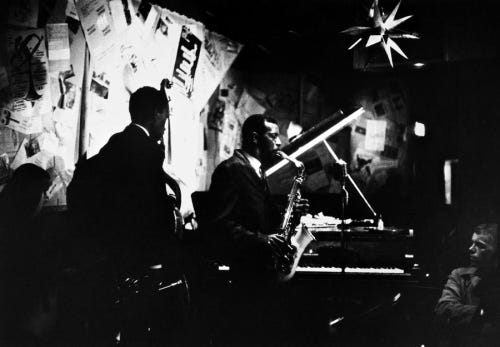
Here is a photo of Coleman with Don Cherry at the Five Spot, uncredited, captured from “The 1959 Project”
- The Jimi Hendrix Experience American premiere at Monterey Pop (1967)
Begin to watch the set closer, “Wild Thing,” at 39:35. Video from D.A. Pennebaker’s documentary film about the festival.
What new works do you know of, in the 21st Century, that have elicited strong responses? Consider writing about them in the comments field.
“Shock” from a more personal perspective
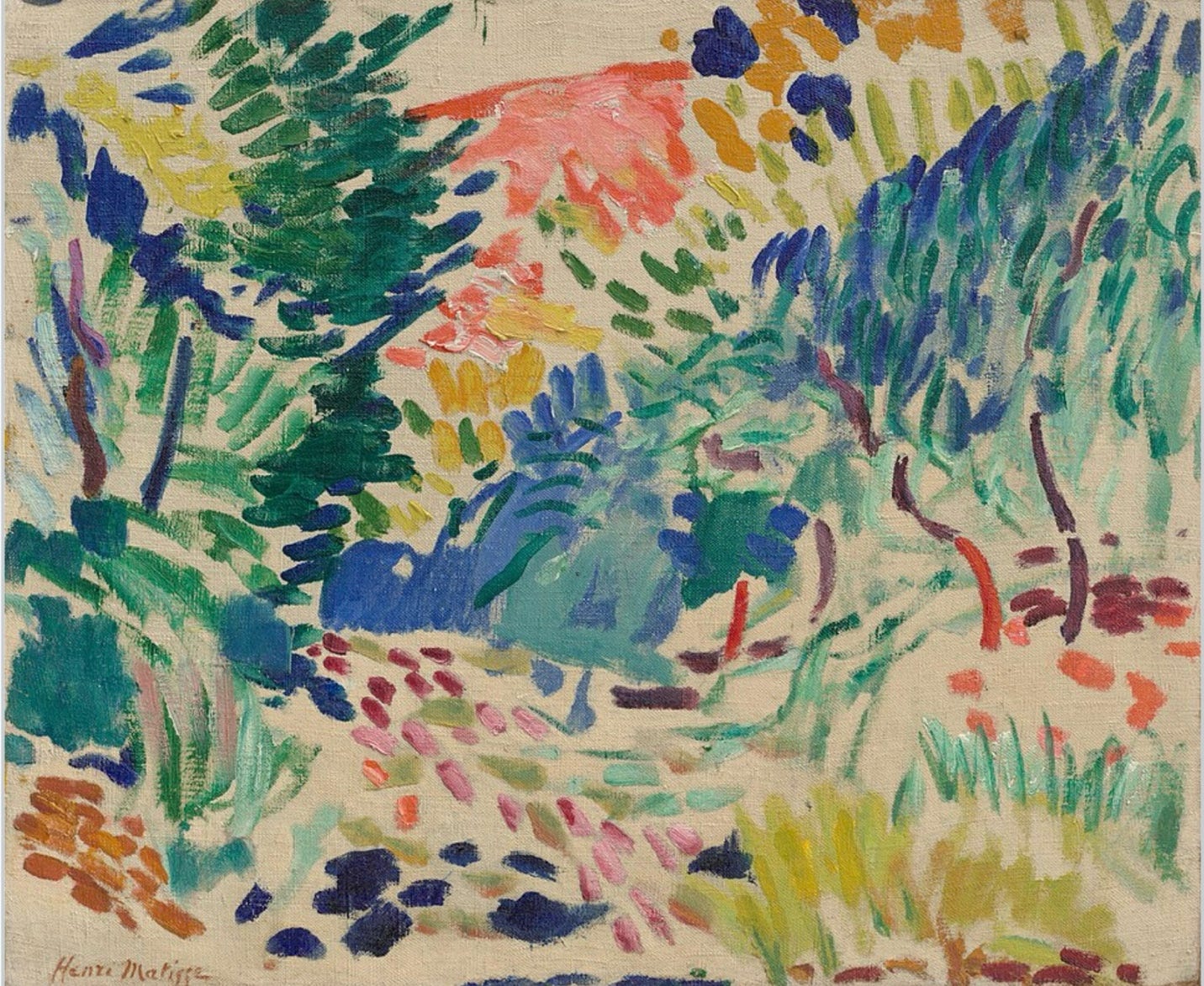
Henri Matisse, “Landscape at Collioure” (1905)
In a previous Substack, I quoted painter Henri Matisse, who viewed the role of the artist as to shock, or as he put it, “… to express the bolt of lightning one senses upon contact with a thing....”
Matisse wasn’t reactions by the public, but something more internal - receiving, as if in a bolt of lightning, a “communication” from the artist. The message is that artist’s experience of seeing something new or “as if” for the first time. For Matisse, the world around us can be startling if we look with fresh eyes. This is what an artist can convey through their work. This is summed up in his next sentence:
“The function of the artist is not to translate an observation but to express the shock of the object on his nature; the shock, with the original reaction.”
Have you had experiences akin to Matisse? An easy answer would be witnessing the birth of an infant.
But Matisse asks about the potential immediacy of anything we encounter. It is a valuable idea to ponder in a time when the daily news is constantly shocking. Shock and its neighbor, numbness, seem normalized. This is all the more reason to practice sensitivity to the normal things surrounding us, which become something deeper than normal when we really look.
Here is some music that immediately altered my own perceptions of music.
Background: My childhood sense of what is or is not to be considered musical was heavily conditioned by seven years at the Julliard between the ages of nine and sixteen. While there, I essentially filtered out anything that was not considered normative within those walls, even the Beatles. However unfortunate that may have been, it gave me a lot to react against after I left. It also resulted in a lot for me to discover. A few years later, when I returned to study with my piano teacher at Julliard, Regina Rubinoff, I discovered that she herself was involved in contemporary music and art. She wasn’t locked within the walls of the institution and she became my close friend for life.
Discovering Jimi Hendrix
I remember the first time I paid close attention to something completely unfamiliar to me. I had heard Jimi Hendrix’s album Are You Experienced and for some reason, out of character, it became the first album I ever purchased. I have no idea why. But I listened again and again on my little RCA all-in-one record playing. I felt unexpectedly struck by the immediacy of Hendrix’s “tightrope walk” between pitch and distortion; noise was as musical as anything else. I felt off balance for days. This was a profound experience, and it opened the door to my subsequent musical experiences.
The next day, I forgot to practice the Bach, Beethoven, and Chopin I was preparing for my next lesson (which didn’t go well). I felt unable to do any music at all for the rest of the week. I just listened to the Hendrix album. By the next week, a stern admonishment by my teacher returned me to practicing again, but that didn’t last long. Within a couple of months, my parents and I were shopping for electric pianos at Sam Ash Music.
The Jimi Hendrix Experience performing the song “Are You Experienced” at Winterland, in San Francisco (audio only). The date was October 11, 1968, 14 months after the US release of the album, a year and a half it was first recorded, and six months before I first heard it.
And then…
There were two other albums when I was in my teens that kept me up, repeatedly listening well into the night. First was Robert Fripp’s searing solo from the second side of King Crimson’s album Lizard (1971). A few years later, it was the eery stillness of Miles Davis’s “He Loved Him Madly” (1974). Each felt like a cipher that maybe I could comprehend, but each resisted getting too close. That was a new way of listening, intently without any way to cognitively explain.
What about you?
What are some musical experiences that felt startlingly to you? Which ones have shaken you or reached you in a way you could not have predicted? Is there one that changed the way you think of music?
Notes:
The Matisse quotation is from his “Interview with Jacques Guenne, 1925,” included in Matisse on Art. Jack D., Flam, ed., Berkeley: University of California Press, 1995.
All of the 20th Century musical works I list premiered during or immediately following Matisse’s lifetime (1869-1954).
John Cage “prepared” pianos by inserting screws, pieces of rubber, and other objects between the strings, to transform the piano into a one-personal percussion ensemble.
Hey Bob — I love this post and love this question. Music has always been a bit peripheral in my life — a sometimes pleasure, often connected with social experiences. Which makes me think about artistic memory. I have a narrative memory of books that have electrified me, foods I’ve tasted that have rocked my world. Visual art too, though that’s a more recent story. But not music so much: I remember scenes of my musical life (my dad playing Italian opera for me when I was a tiny tyke and quizzing me about the arias and singers, dancing around the Catholic Worker house to Springsteen at the wedding of two community members, an epic Gogol Bordello concert…). Lots of music that has brought delight, but more as a soundtrack than as an experience in itself. What you describe here seems like a whole different kind of encountering music. Food — notes — for thought!
A couple for me...Bjork Vespertine a friend told me about her early works, which I thought were awful. But Vespertine has an aural smorgasbord that I found irrisistable! The other is Robert Wyatt's Rick Bottom. Weird, wonderful music that I love to this day. Mike Oldfield's guest appearance on the last track features some amazing "stop-go" guitar!
Very interesting column!!